Vana · primary maths · Hindi and English

An operating system for teaching maths in primary school.

Each child is paired with a device running Vana's personal adaptive learning (PAL) system, built on decades of education research. It gives the student questions at their level, explains concepts when they are stuck, and moves them forward once they achieve mastery.

The teacher stops picking and marking work, and spends the hour doing what only a teacher can: teaching.

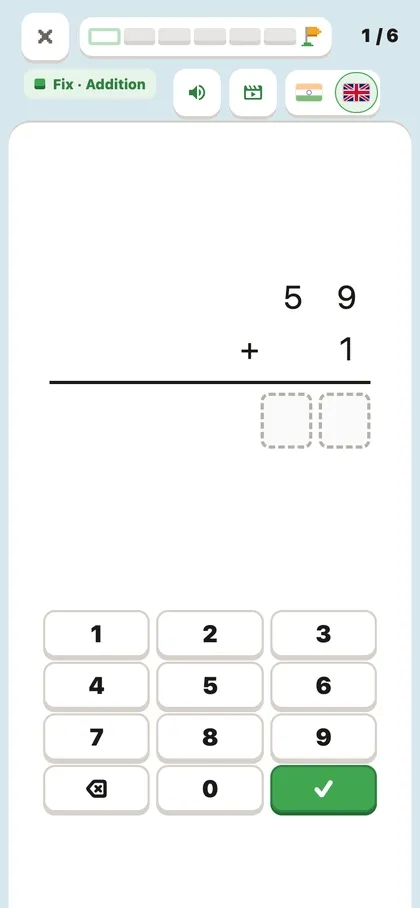
A vana question: 7586 plus 1244 in columns with four answer boxes and a number keypad
The problem

Capability cannot be built on missing basics.

Arithmetic is the floor everything else stands on: trades, accounts, science, code. Our thesis is that this is a large part of why so much of India's workforce ends up in gig work and jobs with no ladder. Skilling at eighteen cannot make up for foundations that were never laid at eight. The national numbers show the size of the gap:

3 in 10class-5 children in rural India can do a simple division sum.ASER 2024
1 in 3class-3 children can do a two-digit subtraction.ASER 2024
~15%higher adult earnings for each big step up in basic maths and reading skills — the strongest lever a childhood has.Hanushek & Woessmann
How it works

Decades of research, applied through Vana.

A Vana session is one hour a day. Each child is taught one skill-concept at a time, and moves on only after they have consistently shown mastery in that skill. Skills that are yet to be mastered keep coming back, mixed together and spaced over days — because the biggest problem for children who are behind is not learning things, but retaining them.

Teaching each child at her own level, rather than her grade's, is the approach India's largest education studies support: Banerjee et al. 2017 (Teaching at the Right Level) · Muralidharan et al. 2019 (adaptive software, Delhi).

Check-in: 46 minus 3 in columns, a countdown, and no hints anywhere

Check-in

7 minutesSilent

The day starts with a short, silent test of skills the child learned on earlier days. No hints, no ticks, no help of any kind. Answering alone, days after being taught, is the cleanest measure of what she has actually kept, so it happens before any teaching can remind her.

The research behind it

Getting a question right with a hint proves the child can follow help. Getting it right alone, days later, proves the skill is theirs. In a well-known experiment, students who were tested on material remembered far more a week later than students who re-read it — recalling something unassisted is what fixes it in memory. That is why check-in allows no hints and runs before any teaching: a hint, or a lesson minutes earlier, would make the score measure the help instead of the child.

Roediger & Karpicke, 2006
Quick factsScreen and video coming

Quick facts

5 minutes

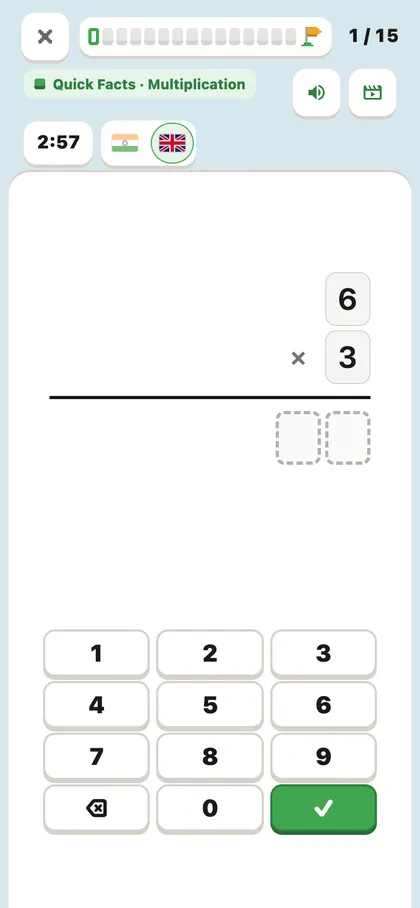
Small facts like 7 + 5 and 13 − 8 should come from memory, not from counting. These five minutes drill exactly the facts a child still works out on her fingers, until they are instant.

The research behind it

A child's working memory is small. If 13 − 8 takes five seconds of counting, there is nothing left over for the borrowing she is actually trying to learn. Instant facts are the foundation every harder skill stands on, which is why they get their own daily lane.

Baroody, 2006 · Ashcraft & Krause, 2007
A video title card: Pip above the words Carrying, twice, with a play button

New skill

30 minutes

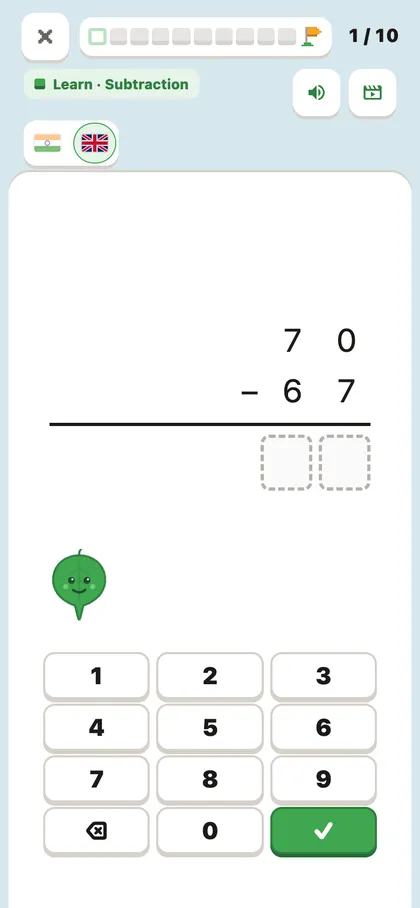
The one skill the child is currently mastering. It is practised with three levels of hints, a short video explainer, and Pip, our AI teacher. Two practice sets in a row at 80% or more, and the skill is ready to be proven.

The research behind it

Letting a student reach mastery before moving on to a new skill is one of the most consistent findings in education research, worth roughly an extra half-year of progress in classroom studies. Maths skills stack: a gap left in this skill becomes a wall in the next one. Vana follows where your student is — it does not run after the syllabus.

Bloom, 1968 & 1984 · Kulik et al., 1990
Mix it upScreen and video coming

Mix it up

20 minutes

Vana collects the skills the child has learned most recently and shuffles questions from them together. Every question makes the child decide which method it needs — the one thing a worksheet of twenty identical sums never asks for.

The research behind it

Students who practise mixed questions score lower during practice and much higher on a test a week later, sometimes double, compared to students who practise one type at a time. Choosing the method, not just running it, is what makes learning stay.

Rohrer & Taylor, 2007
A homework question on the family's phone: 7586 plus 1244

Homework

Every morning · 5 questions

Five questions the child can do entirely on their own: one drawn from their past mistakes, three at the hardest level they have already proven, and one from a different topic, at the level they have proven there. The set goes to the parent's phone on WhatsApp each morning and marks itself.

The research behind it

Practice spread across days is what makes memory last; the same practice crammed into one sitting fades within a week. Homework is the daily dose of that spacing, kept at the level the child already owns, because unsupervised struggle mostly teaches guessing.

Cepeda et al., 2008 · Betts, 1946

Swipe to see each part of the hour →

A research-backed mastery engine
245problem types, each tracked per child
49explainer videos, in Hindi and English
1,000+recorded voice prompts, so a slow reader hears the question
1,400+automated tests on the rules above
Mastery states

How a skill is mastered.

Every skill is tracked on its own, and it only moves forward on proof.

What a skill is

A skill is one small, specific step: "two-digit subtraction with borrowing", not "subtraction". Vana tracks 245 of them, ordered so each builds on the ones before it.

Because every step is tracked separately, each child gets her own road map: the system knows exactly which steps she owns, which one she is on, and which comes next.

One child, one topic, today
Two-digit subtraction, no borrowingSolid
Two-digit subtraction with borrowingProven
Two-digit, borrowing across a zero (40 − 8)Learning
Three-digit subtraction with borrowingNot started
The mastery engine

Every skill is always in exactly one of six states.

Not started

A skill that has never been taught or tested. It opens up once the skills it builds on are proven.

Learning

The skill she is learning today, with hints and videos allowed. Two practice sets in a row at 80% or more, and it moves on.

Waiting for proof

Once learned, the skill appears in tomorrow's check-in, with no help and no feedback. 80% or more makes it Proven. Under 60% sends it back to Learning.

Proven

She passed a check-in with no hints and no warm-up. From here the skill returns at growing gaps: after 1 day, then 3, 7, 14, 30, 60 and 90.

Solid

Three checks in a row at 90% or more, spread over at least three weeks.

Lapsed

A check scored under 60%. The skill goes back to Learning and is retaught.

Results

80% of students moved up an ASER level.

Vana ran a small pilot with Sakshi, a non-profit that runs community schools in Gurugram: one hour a day, five days a week, for six weeks. Students were picked at random and tested before and after on the same national test.

4 of 5students moved up a full level

Four of the five class-2 students on Vana climbed at least one level on the ASER arithmetic test; the fifth was already at the top of the test on day one. Of the 15 classmates who did not use Vana, three moved up, eleven stayed exactly where they were, and one moved down. The odds of this gap being luck: about 1 in 130.

moved uptop of the test on day one
6 of 6moved up at the second school

At the second school, ten class-4 students used Vana. Every one of the six who still had room on the test moved up a rung.

I have been teaching borrowing in subtraction for months, and this is the first time I see the children grasp it.
Class teacher, Nai Umang
I have seen students go from drawing sticks to count, to counting in their minds.
Pip, the peepal-leaf mascot
Who is building this

Madhav is a Y Combinator and McKinsey alum who built and deployed AI-powered maths tools in the US. He recently moved to India to work on foundational learning and is partnering with non-profits, tuition teachers and schools to improve numeracy. He also teaches in a classroom on a daily basis.

If you work in this space, or want to: madhav.mohan1227@gmail.com